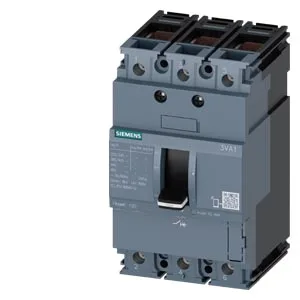
What this MCCB carries
The Siemens 3VA1020-2ED36-0CH0 is a SENTRON molded case circuit breaker (MCCB) sized for line protection in distribution panels. Its 20 A rated continuous current holds steady through 55 °C before the thermal curve starts to derate — at 70 °C it still delivers 18 A, which matters if this breaker sits in a hot enclosure near other heat sources. Breaking capacity is the headline number for fault coordination: 52.5 kA at 240 V, 32 kA at 415 V, 13.6 kA at 440 V, and 7.5 kA at 690 V. That 32 kA at 415 V covers most European industrial mains; the 690 V figure tells you it can handle a 690 V line-to-line system, but the available fault current on that winding needs to stay under 7.5 kA. The TM210 overcurrent release is a thermal-magnetic design — fixed thermal pickup for overload, magnetic for short-circuit. No electronic adjustment, no communication function, no phase-failure detection. It is a straightforward, replaceable-trip MCCB for standard feeder protection.
Panel fit and auxiliary wiring
Three-pole, 70 mm deep, 76.2 mm wide, 130 mm tall. The 76.2 mm width is a standard 3-pole MCCB footprint — it drops into a typical SENTRON mounting base without panel rework. IP40 on the front means it is protected against tools and wires >1 mm but not against water ingress; keep it inside a sealed enclosure if washdown is nearby. Comes with 2 auxiliary switches plus 1 trip alarm switch (HQ version). That gives you two NO/NC pairs for status feedback to a PLC or indicator lamp, plus a dedicated alarm contact that changes state only when the breaker trips on fault — not on manual open. The undervoltage release (UVR) is built in; if the control voltage drops below its dropout threshold, the breaker opens. That is a standard safety feature for machinery where loss of control power should kill the load.
