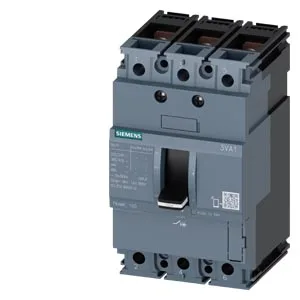
Siemens SENTRON 3VA1020-3ED32-0BA0 — 20 A MCCB with undervoltage release
The Siemens SENTRON 3VA1020-3ED32-0BA0 is a 3-pole molded case circuit breaker (MCCB) rated for line protection, carrying a continuous current Iu of 20 A at ambient temperatures up to 50 °C, with a slight derating curve above that — 19.2 A at 55 °C down to 18 A at 70 °C. The TM210 thermal-magnetic release handles overload and short-circuit protection; the interrupting capacity hits 75.6 kA at 240 V and 52.5 kA at 415 V, which covers most industrial distribution panels and motor control center infeeds.
The 75.6 kA at 240 V and 52.5 kA at 415 V tell you the maximum fault current this MCCB can safely clear at those voltages. In practice, that means it can be installed downstream of transformers or busbars with high available fault current — typical for 240 V distribution in North American panels or 415 V systems in IEC markets.
The 3VA1020-3ED32-0BA0 measures 76.2 mm wide, 130 mm high, and 70 mm deep — standard 3-pole MCCB footprint for the SENTRON 3VA platform. No communication module or phase-failure detection is built in — this is a straightforward line-protection breaker.
Undervoltage release — what it does and why it matters
The undervoltage release (UVR) is a separate release coil that trips the breaker when its supply voltage falls below a threshold. On this unit, the UVR is factory-fitted (design: undervoltage release). That means the breaker will open if control power is lost — useful for preventing automatic restart after a voltage dip, or for integration into an emergency-stop chain where loss of the safety circuit should drop the breaker. There is no voltage trigger or trip indicator on this variant, so the only trip indication is the handle position.
Temperature derating — what 20 A really buys you
Above that, it derates linearly: 19.2 A at 55 °C, 18.8 A at 60 °C, 18.4 A at 65 °C, and 18 A at 70 °C.