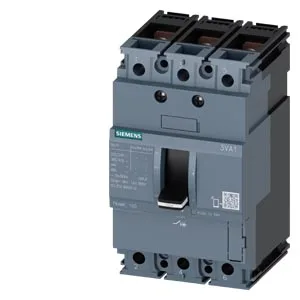
What this MCCB is and what it protects
The Siemens SENTRON 3VA1020-3ED32-0BC0 is a 3-pole molded case circuit breaker (MCCB) designed for line protection — meaning it sits at the feeder or sub-feeder to protect cables and busbars from overload and short circuit, not a specific motor or device. Rated 20 A continuously at 40 °C (derates slightly to 19 A at 60 °C), it's sized for moderate branch circuits in commercial or industrial distribution panels.
Breaking capacity — what those voltage columns mean
This breaker carries a symmetrical interrupting capacity of 75.6 kA at 240 V AC, 52.5 kA at 415 V, 32 kA at 440 V, and 7.5 kA at both 500 V and 690 V. The steep drop above 440 V is typical for an MCCB with a 20 A frame — at higher system voltages the arc energy is harder to quench, so the breaker is only rated for those lower fault levels. For a 480 V panel (common in North America), the 32 kA at 440 V is the closest reference; if your available fault current exceeds that, you'd need a current-limiting upstream device or a higher-rated frame.
Auxiliaries and releases — built-in, not add-on
Factory-fitted with an undervoltage release (UVR) and two auxiliary switches (HQ design), this variant saves panel space and wiring time compared to ordering the base breaker and snapping on auxiliaries later. The UVR trips the breaker when control voltage drops below a threshold — typical for emergency-stop or undervoltage protection schemes. The auxiliary switches provide remote status (open/closed) to a PLC or indicator lamp.
Dimensions and panel fit
At 70 mm deep, 76.2 mm wide (3 inches), and 130 mm tall (5.12 inches), this breaker occupies a standard 3-pole MCCB footprint.
