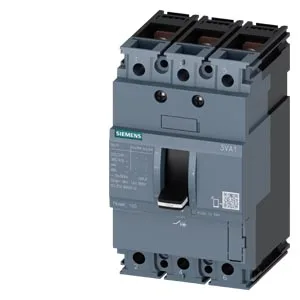
What the interrupting ratings mean for your panel
The Siemens 3VA1020-3ED32-0KC0 is a 3-pole SENTRON molded case circuit breaker (MCCB) designed for line protection. Its interrupting capacity is the headline spec for a sourcing decision: 75.6 kA at 240 V, 52.5 kA at 415 V, 32 kA at 440 V, and 7.5 kA at both 500 V and 690 V. That means at a 415 V industrial service, this breaker can safely clear a fault current up to 52.5 kA without rupturing — critical for ensuring the upstream transformer and buswork are protected. The 20 A continuous rating holds flat from 40 °C through 55 °C, then derates to 19 A at 60 °C through 70 °C, so in a warm panel you lose 1 A above 55 °C ambient.
Fit and integration — DIN rail or direct mount
The breaker measures 130 mm high, 76.2 mm wide, and 70 mm deep. That 70 mm depth is the dimension that matters when you're closing a gland plate or fitting into a shallow enclosure — it's the projection from the mounting surface. The 3-pole footprint is standard for a 20 A MCCB in this class; it mounts on a DIN rail or directly to a backplate. The shunt trip (STL) and two HQ auxiliary switches are factory-fitted, so no field-assembly of accessories is needed — just wire the line and load terminals.
What's on the nameplate — compliance and documentation
The 3VA1020-3ED32-0KC0 carries a rated insulation voltage of 800 V and is designed to IEC/UL standards typical for SENTRON MCCBs. The basic switch variant is 3VA10203ED320AA0; the auxiliary switch configuration is two HQ switches. No undervoltage release, no ground-fault monitoring, and no communication function are fitted on this variant — it's a straight line-protection breaker with shunt trip.
