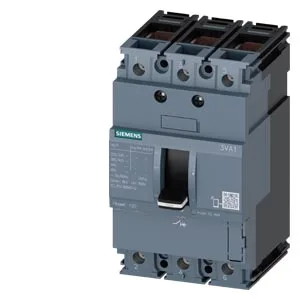
Part identity and what it does
The Siemens 3VA1020-3ED36-0AF0 is a SENTRON molded case circuit breaker (MCCB) designed for line protection — the primary job is protecting cable runs and distribution buswork from overloads and short circuits, not motor starting duty. It's a 3-pole unit rated 20 A continuous at 40 °C, with a TM210 thermal-magnetic release that gives fixed thermal pickup and magnetic trip settings. That 20 A holds flat from 40 °C through 55 °C, then derates to 19 A at 60 °C and above — so in a warm panel you lose only 1 A, not a full bin rating.
Breaking capacity — what the numbers mean for coordination
Breaking capacity is the headline here: 75.6 kA at 240 VAC, 52.5 kA at 415 VAC, 32 kA at 440 V, and 7.5 kA at both 500 V and 690 V. That 75.6 kA at 240 V is high for a 20 A frame — it means this breaker can interrupt a fault upstream of a large transformer without needing a current-limiting fuse ahead of it. At 415 V the 52.5 kA still covers most industrial distribution panels. The drop to 7.5 kA at 500 V and 690 V is the limit of the TM210 release's arc extinction; if your system voltage sits above 480 V, verify the available fault current stays under that 7.5 kA or step up to a higher-frame 3VA1xxx. Insulation voltage is rated 800 V, so the breaker itself is insulated for 690 V systems — the limitation is the interrupting ability, not the dielectric.
Physical fit and panel integration
Dimensions: 130 mm height, 76.2 mm width, 70 mm depth. That 76.2 mm width is exactly 3 inches — three 1-inch pole spaces on a standard DIN rail or panel-mount footprint. The 70 mm depth means it clears most shallow enclosures; no need for a deeper gland plate. Operating temperature range is -25 °C to +70 °C; storage from -40 °C to +80 °C. The trip indicator gives a visible red flag when the breaker has tripped on fault — useful for a maintenance tech walking a line who needs to spot the open breaker without opening the panel door and metering every load.
