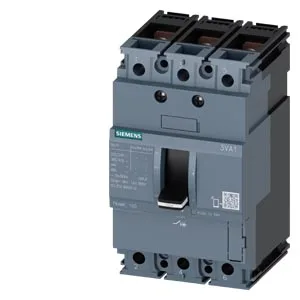
What this MCCB is and what it does
The Siemens 3VA1020-4ED32-0CA0 is a SENTRON molded case circuit breaker (MCCB) designed for line protection — it sits at the feeder or branch in a distribution panel, protecting cables and downstream equipment against overloads and short circuits. It is a 3-pole unit rated 20 A continuous at 40 °C (derates to 19 A at 65 °C), with a TM210 thermal-magnetic overcurrent release — the thermal element handles overload timing, the magnetic element handles instantaneous short-circuit pickup. The breaking capacity is 121 kA at 240 V AC, 75.6 kA at 415 V, 52.5 kA at 440 V, and 11.9 kA at 500 V or 690 V — numbers that define where this breaker can safely interrupt a fault without welding contacts or venting plasma. Rated insulation voltage is 800 V.
Built-in undervoltage release — what that means for the panel
This variant includes an undervoltage release (UVR) as the auxiliary release — if the control voltage drops below a threshold, the UVR trips the breaker open. That is useful in safety circuits or motor starters where a loss of control power should drop the load immediately, rather than letting the breaker stay closed and the motor restart unexpectedly when power returns. No ground-fault monitoring, no communication module, no voltage trigger, and no trip indicator on this variant — it is a straightforward line-protection breaker with UVR, nothing more.
Physical fit and environment
Dimensions are 130 mm high, 76.2 mm wide, 70 mm deep — a standard 3-pole MCCB footprint that fits most DIN-rail or panel-mount enclosures without surprises. Rated for operation from -25 °C to 70 °C, storage from -40 °C to 80 °C, so it handles unheated warehouses and outdoor cabinets as long as the ambient stays within that band. Maximum power loss is 14.5 W — factor that into enclosure thermal calculations if the panel is tightly packed.
