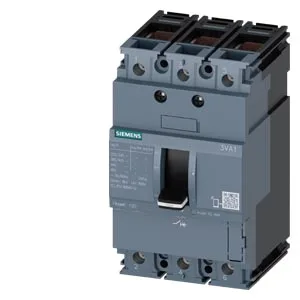
It carries a 20 A rating at 40 °C (flat to 55 °C, then derating to 19 A at 70 °C) across three poles, with a TM210 thermal-magnetic overcurrent release that handles both overload and short-circuit trip curves. An undervoltage release (UVR) is built in, so the breaker drops out when control voltage falls below the dropout threshold, a common requirement for emergency-stop chains or undervoltage protection schemes.
Breaking capacity across voltages
The interrupting rating varies with system voltage: 121 kA at 240 V, 75.6 kA at 415 V, 52.5 kA at 440 V, and 11.9 kA at both 500 V and 690 V. That drop at higher voltages is typical for a thermal-magnetic MCCB — the arc extinction gets harder as voltage rises. For a 400 V distribution panel, the 75.6 kA figure gives substantial SCCR headroom against most transformer-fed faults.
The breaker measures 76.2 mm wide, 130 mm tall, and 70 mm deep — a standard 3-pole MCCB footprint that fits Siemens' own SENTRON mounting plates and most DIN-rail adapters. The supplied basic switch (3VA10204ED360AA0) is the core switching mechanism; the order code adds the UVR and TM210 release as factory-installed options.