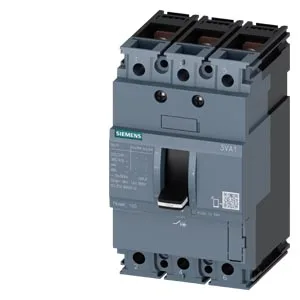
What it is and what it does
The Siemens 3VA1025-2ED32-0AA0 is a 3-pole molded case circuit breaker (MCCB) from the SENTRON series, designed for line protection — meaning it protects cables and distribution buswork against overload and short-circuit, not motor or generator circuits. Rated 25 A at 40 °C (continuous current holds flat through 50 °C, then derates to 23 A at 70 °C), with a breaking capacity of 52.5 kA at 240 V AC and 32 kA at 415 V AC — enough for most industrial distribution panels fed by a transformer in the 500–1000 kVA range. The overcurrent release is a TM210 thermal-magnetic type — fixed thermal and magnetic trip settings, no electronic adjustment. That keeps the part simple and reliable for standard feeder protection, but means you cannot dial in a different trip curve on site.
Breaking capacity across voltages — what it means for your panel
At 440 V the breaker interrupts 13.6 kA; at 500 V and 690 V it drops to 7.5 kA. If your system fault current at the panel exceeds those numbers at the operating voltage, you need a higher-rated MCCB upstream or a current-limiting fuse ahead of this breaker. Rated insulation voltage is 800 V, so the breaker itself can be used in 690 V systems — the lower interrupting capacity at that voltage is the limiting factor, not the insulation.
Physical fit and panel integration
Dimensions are 130 mm high, 76.2 mm wide, 70 mm deep — a standard 3-pole MCCB footprint that fits most Siemens SENTRON distribution panels and many third-party enclosures with a 3 x 76.2 mm cutout. The front face carries IP40 protection (no water jets, but solid objects larger than 1 mm are kept out). No undervoltage release, no shunt trip, no communication module — this is a bare thermal-magnetic breaker. If you need remote tripping or status feedback, you will need to add accessories or pick a different variant.
Lifecycle and sourcing reality
Maximum power loss is 8.5 W — negligible for thermal budgeting in a panel, but worth noting if you are packing many breakers in a sealed enclosure without forced ventilation.