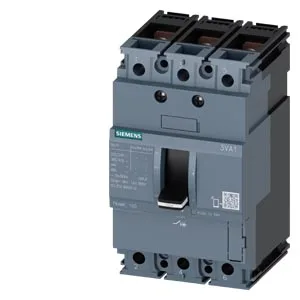
The TM210 thermal-magnetic release provides overload and short-circuit protection, while the integrated undervoltage release (UVR) allows a control signal to trip the breaker — useful for emergency-stop or interlock circuits where loss of control voltage must open the load. Breaking capacity spans 52.5 kA at 240 V down to 7.5 kA at 690 V, so the SCCR coordination study needs to match the available fault current at the installed voltage. At 415 V it interrupts 32 kA; at 440 V, 13.6 kA.
Full 25 A rating holds through 50 °C ambient; above that it derates linearly to 22.5 A at 70 °C. If the breaker shares a crowded enclosure with heat-generating devices, factor the actual ambient at the breaker inlet — not the room temperature — when sizing the load. The IP40 front protection means it's sealed against tools and small objects but not against dust ingress — suitable for clean indoor panels, not washdown areas.
Auxiliary contacts and release options
The auxiliary contacts signal breaker position (open/closed) to a PLC or status lamp; the alarm switch changes state only on a trip event, distinguishing a manual-off from a fault. The undervoltage release (UVR) is wired separately — if its coil loses power, the breaker opens. For frequent switching applications, check the electrical endurance curve in the device manual.