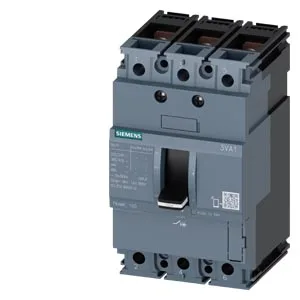
Three poles, rated 25 A at 40 °C, with a 52.5 kA interrupting capacity at 240 V AC.
Rated current holds at 25 A from 40 °C through 50 °C, then steps down to 24 A at 55–60 °C and 23 A at 65–70 °C. The 25 A frame is the thermal-magnetic trip point; if your continuous load is near 25 A in a warm enclosure, you need the derated numbers to avoid nuisance tripping. Breaking capacity drops as voltage rises: 52.5 kA at 240 V, 32 kA at 415 V, 13.6 kA at 440 V, and 7.5 kA at 500 V and 690 V. The 415 V figure is the one most European industrial panels will care about — 32 kA covers most secondary distribution scenarios short of a transformer directly upstream. The undervoltage release (UVR) is built in — this variant ships with the UVR as standard, so the breaker drops out if control voltage falls below the dropout threshold, which is typical for emergency-stop chains or undervoltage protection on motor feeders.
That gives you two independent status contacts for PLC or indicator lamps, plus a dedicated alarm contact that changes state only on a trip event — useful for remote fault annunciation without wiring through the main breaker terminals.