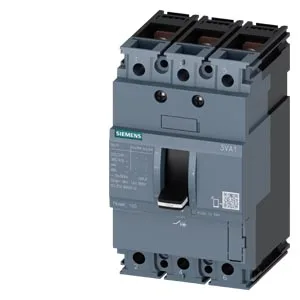
Its interrupting capacity hits 121 kA at 240 V and 75.6 kA at 415 V — numbers that matter when you're coordinating selectivity downstream of a transformer or a large motor branch.
At 240 V this breaker clears 121 kA symmetrical; at 415 V it's 75.6 kA, at 440 V it's 52.5 kA, and at 690 V it's 11.9 kA. That's a steep voltage-dependent drop — if your panel feeds a 690 V motor circuit, the available fault current must stay under 11.9 kA or you need a higher-rated frame. The 25 A rating holds flat from 40 °C to 50 °C, then derates to 24 A at 55 °C and 22.5 A at 70 °C. In a hot enclosure near the top of a panel, that 70 °C figure governs the actual load you can protect.
The shunt trip (STL) is the only integrated auxiliary release, so if you need undervoltage release or ground fault monitoring, this variant does not carry them.