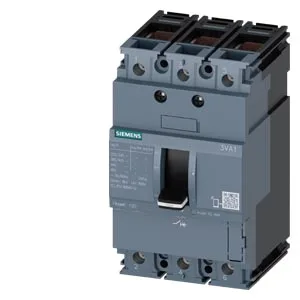
The 52.5 kA interrupting capacity at 240 V gives solid fault-clearing headroom for industrial feeder circuits; at 415 V it still breaks 32 kA. A built-in shunt trip (STL) auxiliary release lets a remote signal or safety circuit open the breaker independently of the overcurrent mechanism — useful for emergency-off or interlock schemes. Three-pole construction with 800 V rated insulation voltage means it suits 400 V three-phase systems with margin.
Thermal-magnetic curve and release design
The TM210 overcurrent release uses a thermal bimetal for overload protection and a magnetic coil for short-circuit response. Rated current holds steady at 32 A from 40 °C up to 50 °C, then gently tapers to 30 A at 70 °C — a mild derating curve that keeps the breaker usable in warm cabinets without oversizing. The magnetic trip threshold (not listed in this data set) typically tracks the TM210 family's fixed multiple of In. No trip indicator is fitted, so fault events won't leave a visual flag on the breaker face.
Panel integration and auxiliary wiring
Mounts into a standard panel cutout for 3VA three-pole frames. The shunt trip (STL) requires a separate control voltage to operate — wire it through a normally-open contact from the safety relay or E-stop circuit. No communication function or measurement capability is built in, so this is a straight protection device, not a smart breaker.