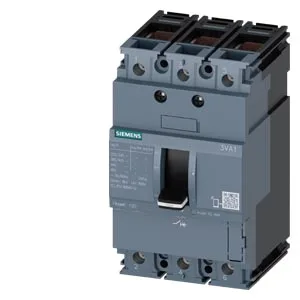
Rated 32 A at 40 °C with a TM210 thermal-magnetic release, it handles overload and short-circuit protection on 3-phase systems up to 800 V insulation voltage.
Breaking capacity — what the voltage ratings mean
The interrupting capacity drops as system voltage rises: 75.6 kA at 240 V, 52.5 kA at 415 V, 32 kA at 440 V, and 7.5 kA at both 500 V and 690 V. For a 400 V panel, the 52.5 kA figure gives comfortable headroom above the typical 25–36 kA available fault current in most industrial installations. At 690 V, the 7.5 kA rating still covers low-fault scenarios like motor control centers with upstream current-limiting fuses.
Thermal derating and power loss
The breaker holds its full 32 A rating from 40 °C up to 50 °C, then derates to 31 A at 55–60 °C and 30 A at 65–70 °C. Maximum power loss is 10.6 W — negligible for panel thermal budgeting but worth noting in a sealed enclosure with multiple breakers side by side.
Auxiliary switch and trip indication
A visible trip indicator on the front face confirms the breaker has opened on a fault — useful during troubleshooting without needing to open the panel door.