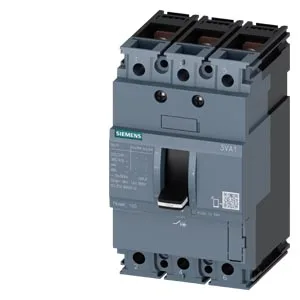
MCCB for line protection with high fault-current capacity
It ships with two auxiliary switches plus a separate trip alarm switch, letting the PLC or BMS know the breaker's state and whether it tripped on fault versus manual open.
Interrupting ratings across voltages
This MCCB's breaking capacity varies by system voltage: 121 kA at 240 V, 75.6 kA at 415 V, 52.5 kA at 440 V, and 11.9 kA at both 500 V and 690 V (–). The drop at higher voltages is typical for air-break MCCBs — arc extinction gets harder as voltage rises. For a 480 V panel, you'd use the 440 V figure as a conservative proxy; at 52.5 kA, that still covers most industrial service-entrance scenarios.
That's a shallow derating curve — only 2 A lost over a 30 °C rise — so it's forgiving in a warm enclosure. Maximum power dissipation is 13.1 W, which you'll want to factor into your panel thermal budget if you're stacking several breakers side by side.
The 70 mm depth means it fits in shallow enclosures where a deeper breaker would hit the gland plate. The undervoltage release coil and auxiliary switches are factory-integrated, so no field-assembly of accessories is needed.