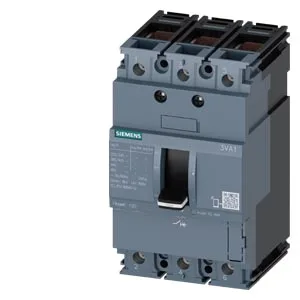
What this MCCB is and what it does
The Siemens SENTRON 3VA1032-4ED36-0AC0 is a 3-pole molded case circuit breaker (MCCB) designed for line protection — meaning it protects cables and distribution buswork, not motor loads. It carries a continuous 32 A at 40 °C ambient, with the TM210 thermal-magnetic release providing the overload and short-circuit trip curve. The 121 kA breaking capacity at 240 V AC tells you it can safely interrupt very high fault currents on a low-voltage distribution panel without upstream fuses needing to clear first.
Breaking capacity across voltages
This MCCB's interrupting rating drops as system voltage rises: 75.6 kA at 415 V, 52.5 kA at 440 V, and 11.9 kA at both 500 V and 690 V. The 690 V figure is the same as the 500 V figure, which is typical for a breaker whose arc extinction is optimised for the lower voltage range. For a 400 V distribution board (common in European industrial panels), the 75.6 kA rating gives comfortable margin above the typical 25–50 kA prospective fault level.
Thermal derating and power loss
The breaker holds its full 32 A rating up to 50 °C, then derates to 31 A at 55–60 °C and 30 A at 65–70 °C. That's a shallow derating curve — only 2 A lost over a 30 °C rise — so it suits panels with modest internal temperature rise. Maximum power loss is 10.6 W, which matters for enclosure heat load calculations when grouping several breakers in a small cabinet.
Physical fit and panel integration
Dimensions are 130 mm high, 76.2 mm wide, and 70 mm deep. The 76.2 mm width is a standard 3-module footprint on a DIN rail or mounting plate, so it occupies the same panel space as other 3-pole SENTRON MCCBs. The 70 mm depth means it clears most shallow enclosures without needing a gland plate extension.
