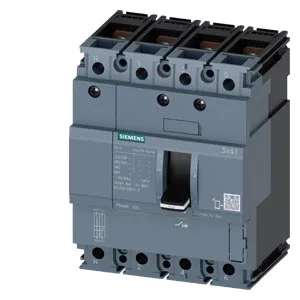
The TM210 release combines a thermal bimetal for overload protection and a magnetic coil for short-circuit protection — the '210' designates the fixed magnetic trip threshold at 10× In (320 A, adjustable down to 320 A as the li max setting). This part is line-protection version (no ground-fault monitoring, no N-conductor protection, no communication function).
Breaking capacity — the real-world fault current limits
At 240 V it breaks 121 kA — a very high rating for a 32 A frame, suitable for large transformer secondaries or bus-duct feeds. At 415 V it still handles 75.6 kA; at 440 V it drops to 52.5 kA; at 500 V and 690 V it holds at 11.9 kA. For a 400 V distribution board with a 50 kA prospective fault, this breaker has headroom.
Thermal derating — how hot can the panel run?
At 55 °C it derates to 31 A, at 60 °C to 31 A, at 65 °C to 30 A, and at 70 °C to 30 A. That is a shallow derating curve — only 2 A lost from 45 °C to 70 °C — which means the thermal element is well-sunk into the frame. If the panel ambient stays under 50 °C, you get full 32 A.
The 3VA1032-4ED42-0AA0 measures 70 mm deep, 101.6 mm wide, and 130 mm tall. The 101.6 mm width (4 inches) for a 4-pole breaker is compact; expect a 4-module-wide cutout on a DIN-rail adapter plate. Front IP40 rating means tools and fingers are safe, but not hose-down.
Electrical ratings and power loss
In a sealed panel with multiple breakers, that heat adds up; plan ventilation if the total dissipation exceeds the cabinet's natural convection capacity.