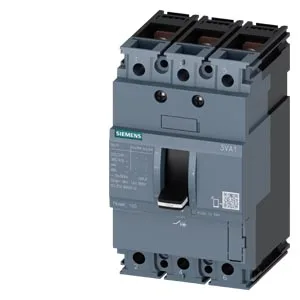
It's a 3-pole unit rated at 40 A continuously from 40 °C up to 50 °C ambient, with a slight thermal derating curve above that — at 55 °C it carries 38.4 A, at 70 °C it's good for 36 A. The breaking capacity tells you where this breaker can clear a fault without welding its contacts shut. At 240 V it interrupts 75.6 kA; at 415 V it's 52.5 kA; at 440 V it drops to 32 kA; and at 500 V or 690 V it still holds 7.5 kA. That's a strong SCCR for a 40 A frame — it gives you selectivity headroom in a main or feeder position without stepping up to a larger frame size. The basic switch assembly is order code 3VA10403ED320AA0.
The 3VA family shares a common accessory platform across frame sizes. This breaker uses the same auxiliary switches and shunt trips.
Dimensions are 130 mm high, 76.2 mm wide, 70 mm deep — a standard 3-pole MCCB footprint that drops into most DIN-rail or panel-mount enclosures without re-drilling. No special derating for ambient below 40 °C — the 40 A rating holds right down to -25 °C.
The 3VA1110-5ED36-0AC0 is a higher-current sibling in the same SENTRON family. Where this 3VA1040-3ED32-0KC0 is a 40 A frame, the 3VA1110 is rated at 100 A. The physical footprint is larger — the 100 A frame uses a wider and taller body, so it won't drop into a panel cutout designed for this 40 A unit without enlarging the opening. Both use the same 3VA accessory system (aux switches, shunt trips), but the breaking capacity curves differ: the 100 A breaker typically has lower interrupting ratings at the same voltage because the higher continuous current stresses the arc chamber harder. If your BOM called for the 3VA1110 and you're considering this 40 A as a substitute, check your load first — this one won't carry a 100 A motor circuit.