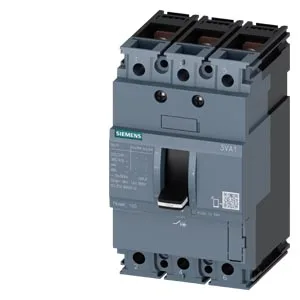
Rated current and breaking capacity — what drives the fit
The Siemens 3VA1040-3ED32-0KH0 is a 3-pole SENTRON molded case circuit breaker rated 40 A at 40 °C, with a continuous current that holds flat to 40 A through 50 °C before derating begins — at 55 °C it carries 38.4 A, at 70 °C it carries 36 A. That thermal profile means the breaker can be applied in a 50 °C panel without any ampacity haircut, which is common in enclosed switchgear or high-ambient machine cabinets. Its interrupting capacity is 75.6 kA at 240 V, 52.5 kA at 415 V, and 32 kA at 440 V — figures that put it in the high-fault category for a 40 A frame. At 500 V and 690 V the rating drops to 7.5 kA, so the breaker is best applied on 240 V to 480 V distribution where fault currents are substantial.
Line protection design and auxiliary options
This variant is configured for line protection — meaning the thermal-magnetic trip curve is set to protect cable and bus runs, not motor or generator circuits. The breaker does not include an undervoltage release or ground-fault monitoring, so if those functions are required on the BOM, they must be added externally or a different 3VA variant selected. Communication function is also absent — this is a standalone thermal-magnetic MCCB, not a metering or networked unit.
The 3VA1040-3ED32-0KH0 measures 130 mm high, 76.2 mm wide, and 70 mm deep — a compact 3-pole footprint that fits standard SENTRON mounting bases and busbar systems. Maximum power dissipation is 10.8 W, which is modest for a 40 A frame. In a densely packed panel this keeps internal temperature rise manageable, but the derating curve above 50 °C should still be checked against the enclosure's thermal profile.