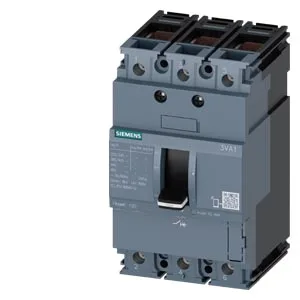
The Siemens SENTRON 3VA1040-3ED36-0DC0 is a 3-pole molded case circuit breaker (MCCB) rated for 40 A continuous current across the 40 °C to 50 °C ambient band, with a slight derating curve starting at 55 °C (38.4 A) down to 36 A at 70 °C. The interrupting capacity tells you where this breaker can safely clear a fault: 75.6 kA at 240 V, 52.5 kA at 415 V, 32 kA at 440 V, and 7.5 kA at both 500 V and 690 V. The drop at higher voltages is typical for a compact MCCB frame; if your system runs at 690 V, verify the 7.5 kA SCCR is adequate for your upstream transformer.
Built-in auxiliary and undervoltage release
This variant ships with two auxiliary switches (HQ type) and an undervoltage release (UVR) factory-installed. The two auxiliary switches provide status feedback (open/closed/tripped) to a PLC or indication lamp. No ground-fault monitoring is included on this version.
The 76.2 mm width (3 inches) is a standard 3-pole MCCB footprint — it occupies three 25.4 mm module positions on a DIN rail.
Environmental limits
The storage limits exceed the operating range, which governs handling and warehousing, not running conditions.