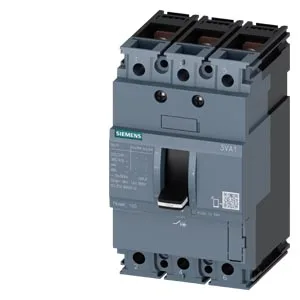
Three poles, 40 A continuous at 40 °C ambient, and the TM210 thermal-magnetic release means the thermal element handles overload timing and the magnetic element trips instantaneously on high fault currents. Breaking capacity is the headline number here: 121 kA at 240 V AC, dropping to 75.6 kA at 415 V and 52.5 kA at 440 V. That 121 kA figure at 240 V tells you this breaker can interrupt a fault current up to 121,000 A without welding or rupturing — critical for high-fault locations like transformer secondaries or large panel mains. At 690 V it still holds 11.9 kA, which is respectable for a 40 A frame.
Rated current holds flat at 40 A from 40 °C up to 50 °C — no derating needed in a warm panel. Above 50 °C it tapers: 38.4 A at 55 °C, 37.6 A at 60 °C, 36.8 A at 65 °C, and 36 A at 70 °C. If your enclosure runs hot, you lose about 10 % of the ampacity at the top end. The breaker itself dissipates 10.8 W max at full load, so factor that into your thermal budget. Dimensions: 130 mm high, 76.2 mm wide, 70 mm deep. That 76.2 mm width (3 inches) is a standard 3-pole MCCB footprint — it fits existing SENTRON mounting bases and busbar systems without panel rework. Rated insulation voltage is 800 V, so it's comfortable on 480 V or 600 V class systems.
What's inside the box — auxiliary and release details
The auxiliary switch design is two HQ switches (form C contacts) for signaling open/closed status to a PLC or indicator lamp. Trip indicator is not fitted, so you won't get a local mechanical flag; you'd rely on the aux contacts or a separate indicator.