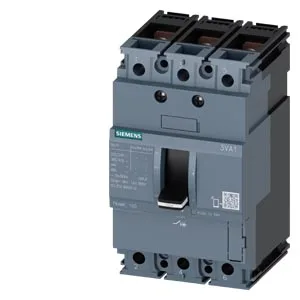
At 240 V it interrupts 121 kA; at 415 V that drops to 75.6 kA, at 440 V to 52.5 kA, and at 690 V to 11.9 kA — so the available fault current at the panel's service entrance decides which voltage column governs your SCCR coordination study. If your BOM calls for a communicating breaker or a UVR-equipped unit, this variant won't deliver it without a field-installable accessory.
Thermal derating — where the 40 A holds and where it tapers
At 55 °C it derates to 38.4 A, at 60 °C to 37.6 A, at 65 °C to 36.8 A, and at 70 °C to 36 A.
The 3-pole footprint matches the standard SENTRON 3VA frame; if your existing panel was cut for a 3VA1010 or 3VA1110 frame, verify the mounting centres against the 76.2 mm width before assuming a drop-in swap.
What the TM210 release means for coordination
The TM210 is a fixed thermal-magnetic release — the thermal element provides long-time protection (adjustable tr max 1 second), the magnetic element provides instantaneous short-circuit pickup. No electronic adjustment of the I²t curve; selectivity with downstream breakers depends on the fixed magnetic threshold. For a distribution board feeding motor starters or lighting panels, this is a standard choice — not a high-end electronic trip unit, but serviceable for most line-protection duties.