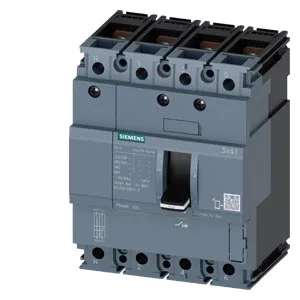
The Siemens SENTRON 3VA1050-2ED42-0AF0 is a 4-pole molded case circuit breaker (MCCB) rated for line protection, carrying 50 A continuously at 40 °C and derating to 45 A at 70 °C. Its TM210 thermal-magnetic release handles overloads and short circuits without external control power, so it's a standalone protective device — no undervoltage release or communication module on this variant.
At 240 V it clears 52.5 kA; at 415 V that drops to 32 kA, then 13.6 kA at 440 V, and 7.5 kA at both 500 V and 690 V. For a 480 V panel (common in North America) the relevant figure is the 440 V or 500 V value — plan your upstream fuse or breaker coordination around the 13.6 kA or 7.5 kA ceiling, not the 240 V headline.
The breaker measures 101.6 mm wide, 130 mm high, and 70 mm deep — a standard 4-pole MCCB footprint for DIN-rail or panel-mount installation. The 70 mm depth leaves clearance for rear-connected busbars or cable lugs in a typical 200 mm deep enclosure.
Auxiliary switching and trip indication
That gives you a dry contact for remote fault annunciation or PLC input — useful for a line-down alarm without adding a separate monitoring relay.
Temperature derating — don't ignore it
Rated 50 A at 40 °C ambient, but at 55 °C it's 49 A, at 60 °C it's 48 A, and at 70 °C it's 45 A. If the breaker lives in a crowded panel near other heat sources, use the 45 A figure for your load calculation — not the 50 A nameplate.
Power loss and thermal budget
Maximum power dissipation is 14.6 W at rated load. That's modest for a 50 A MCCB, but in a sealed enclosure with multiple breakers side-by-side, it adds up — account for it in your panel thermal analysis.