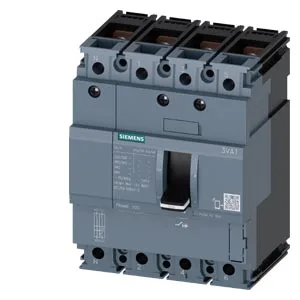
What this 4-pole MCCB carries — and where the ratings matter
The Siemens SENTRON 3VA1050-2ED42-0DC0 is a 4-pole molded case circuit breaker (MCCB) rated for 50 A continuous current at 40 °C, with a TM210 thermal-magnetic overcurrent release and an integrated undervoltage release (UVR). Interrupting capacity scales with system voltage: 52.5 kA at 240 V, 32 kA at 415 V, 13.6 kA at 440 V, and 7.5 kA at 690 V — so the same frame covers 480Y/277 V panels and 690 V motor circuits, but the available fault current at the board must stay under the curve for the tap voltage. Thermal derating is flat through 50 °C (still 50 A), then drops to 48 A at 55 °C and 45 A at 70 °C — useful when the breaker sits in a crowded enclosure near other heat sources; the 70 °C operating max matches the upper ambient limit.
Dimensions are 70 mm deep, 101.6 mm wide, and 130 mm high — the 101.6 mm width is the standard 4-pole MCCB footprint for this SENTRON frame size, so it drops into existing 3VA panel layouts without re-drilling the mounting plate.
Latching endurance is rated at 15 000 operations — typical for a 50 A frame in panelboard duty; not a high-cycle motor-switching breaker, but fine for infrequent manual disconnect and fault clearing.