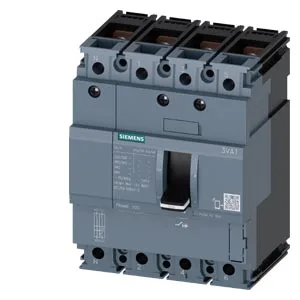
The Siemens SENTRON 3VA1050-2ED42-0DH0 is a 4-pole molded case circuit breaker (MCCB) rated for 50 A continuous current at 40 °C, with a TM210 thermal-magnetic overcurrent release and an integrated undervoltage release (UVR). It's a line-protection device — meaning it sits between the transformer and the distribution bus, not a motor-protection breaker with phase-failure detection. The 52.5 kA interrupting capacity at 240 V gives you headroom for high-fault panels; at 415 V it still holds 32 kA, which covers most industrial service-entrance and feeder applications. The IP40 front rating means it's fine inside a dry enclosure but not washdown-rated.
The 50 A rating holds flat from 40 °C to 50 °C, then derates to 48 A at 55 °C, 47 A at 60 °C, 46 A at 65 °C, and 45 A at 70 °C — so if your panel ambient runs above 50 °C, you lose 1 A per 5 °C step.
Panel integration
Dimensions: 130 mm height, 101.6 mm width, 70 mm depth — that's a standard 4-pole MCCB footprint, so it drops into existing SENTRON or competitive cutouts without panel rework. The IP40 front means the breaker face is protected against solid objects over 1 mm, but the enclosure itself must handle the rest of the IP rating. The spring-cage terminals accept 0.2–2.5 mm² solid or ferruled stranded wire; strip length 8 mm.