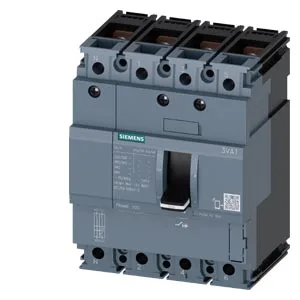
The Siemens SENTRON 3VA1050-2ED42-0KA0 is a 4-pole molded case circuit breaker rated for 50 A continuous current (Iu) across a 40 °C to 50 °C ambient — no derating needed up to 50 °C, then it steps down to 48 A at 55 °C and 45 A at 70 °C. The interrupting capacity climbs to 52.5 kA at 240 V, drops to 32 kA at 415 V, 13.6 kA at 440 V, and 7.5 kA at 690 V.
The breaker measures 70 mm deep, 101.6 mm wide, and 130 mm high — a standard 4-pole MCCB footprint that drops into most SENTRON distribution panels without re-drilling. No auxiliary contact version is fitted (order separately if you need a status feedback contact). The overcurrent release is a TM210 — thermal-magnetic, non-electronic, no communication function, no phase-failure detection. If your spec calls for ground-fault monitoring or an undervoltage release, this variant doesn't carry them; the shunt trip (STL) is the only integrated auxiliary release.