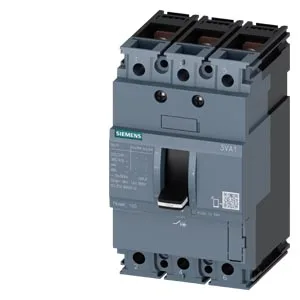
What this MCCB is and where it fits
The Siemens SENTRON 3VA1050-3ED32-0KA0 is a 3-pole molded case circuit breaker (MCCB) rated for 50 A continuous at 40 °C ambient, with a TM210 thermal-magnetic fixed release and an integrated shunt trip (STL) for remote tripping. It is designed for line protection in distribution panels and motor control centers, sized for a 76.2 mm wide, 130 mm tall, 70 mm deep DIN-rail or screw-mount footprint. The TM210 release means the thermal element is fixed at 50 A (the breaker's frame rating), with magnetic pickup at 10× In (500 A). This suits feeder circuits where the load is well-characterized and you don't need adjustable overloads — common in fixed-load distribution, lighting panels, or as a main disconnect for a sub-panel.
Breaking capacity — what the ratings mean for coordination
This MCCB delivers 75.6 kA interrupting capacity at 240 V AC, 52.5 kA at 415 V, 32 kA at 440 V, and 7.5 kA at both 500 V and 690 V. The steep drop above 440 V means you must verify the available fault current at the point of installation — at 690 V the 7.5 kA rating limits it to low-fault locations or downstream of a current-limiting upstream device. The 800 V rated insulation voltage confirms the breaker's internal clearance supports 690 V systems, but the interrupting rating governs the safety decision. For a 400 V panel with a 50 kA SCCR, this breaker's 52.5 kA at 415 V provides headroom. At 480 V systems (common in North America), the 32 kA at 440 V is the closest published point — coordination studies should use that value conservatively.
Thermal derating and operating range
The breaker holds 50 A continuously from 40 °C up to 50 °C ambient. Above that, it derates linearly: 49 A at 55 °C, 48 A at 60 °C, 46 A at 65 °C, and 45 A at 70 °C. If your panel internal ambient runs above 50 °C, size the load or provide forced ventilation to stay within the thermal curve. The operating ambient range is -25 °C to 70 °C; storage range is -40 °C to 80 °C. Maximum power dissipation is 14.6 W — relevant for heat buildup in a multi-breaker enclosure. No communication function, no undervoltage release, no ground-fault monitoring on this variant; the only auxiliary release is the shunt trip.
