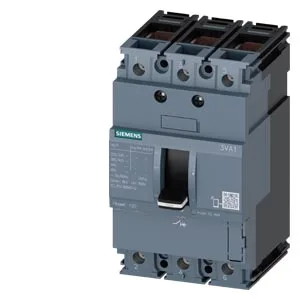
The interrupting ratings tell you where this breaker can be applied: 121 kA at 240 V, 75.6 kA at 415 V, 52.5 kA at 440 V, and 11.9 kA at 690 V. The TM210 overcurrent release means it uses a fixed thermal-magnetic trip curve, not an electronic one; no field adjustment of the long-time pickup, so the 50 A rating is the setting. Thermal derating is modest: the breaker holds 50 A from 40 °C through 50 °C ambient, then drops to 48 A at 55 °C, 47 A at 60 °C, 46 A at 65 °C, and 45 A at 70 °C. For a panel that runs hot — say, 55 °C inside the enclosure — you lose 2 A of headroom. The auxiliary contact version ships with 2 HQ switches.
The width is 76.2 mm (roughly 3 standard module widths on a 25 mm grid), depth 70 mm, height 130 mm. The 3-pole design fits a 3-phase distribution board; the line-protection designation means it is intended for feeder or branch-circuit protection, not motor-starting duty (no adjustable overload curve for motor inrush).
The interrupting ratings across multiple voltage levels (121 kA at 240 V down to 11.9 kA at 690 V) let the designer verify full-selectivity with upstream breakers at each fault-current level. The TM210 release has a fixed long-time delay (tr max. 1 s) and a fixed short-time pickup — no zone-selective interlocking or ground-fault alarm on this variant. For a simple radial feeder where arc-flash energy reduction is not required, this is a clean choice.