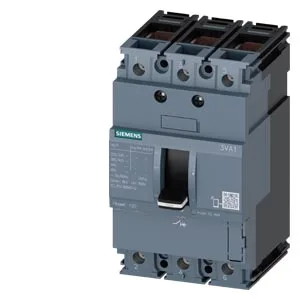
The Siemens SENTRON 3VA1050-4ED36-0AD0 is a 3-pole molded case circuit breaker (MCCB) rated for 50 A continuous at 40 °C, with a TM210 thermal-magnetic release — meaning the thermal element handles overloads and the magnetic element handles short-circuits, no electronic trip unit to program. It's designed for line protection, so it sits at the feeder or branch circuit, not on a motor or generator. Breaking capacity is the number that decides whether this breaker holds or blows upstream: 121 kA at 240 V AC, 75.6 kA at 415 V, 52.5 kA at 440 V, and 11.9 kA at both 500 V and 690 V.
What the TM210 release means for coordination
The TM210 is a fixed thermal-magnetic release — no interchangeable rating plugs, no electronic adjustments. Thermal pickup is fixed at the 50 A frame rating; magnetic pickup is fixed at 10x In (500 A typical for TM releases). That makes selectivity with downstream breakers predictable: you coordinate on the time-current curve without worrying about someone dialing the trip settings. This is a bare line-protection breaker — if you need shunt trip, UVR, or remote signaling, you add auxiliary switches (the design accepts up to 3 auxiliary switches HQ).