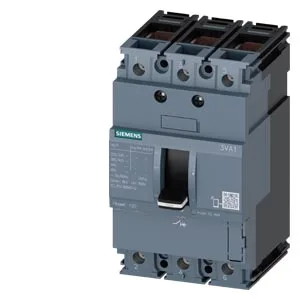
The Siemens 3VA1050-4ED36-0CA0 is a 3-pole SENTRON molded case circuit breaker rated for 50 A continuous current at 40 °C, with a TM210 thermal-magnetic overcurrent release. Breaking capacity reaches 121 kA at 240 V, 75.6 kA at 415 V, 52.5 kA at 440 V, and 11.9 kA at 690 V — per the datasheet, these are the values that govern selectivity coordination downstream. There is no auxiliary contact block fitted from the factory, so if you need status feedback to a PLC, plan for the separate 3VA9608-0BB24 auxiliary trip accessory. Dimensions are 130 mm height, 76.2 mm width, 70 mm depth — the 76.2 mm width (three 25.4 mm pole pitches) is standard for 3VA frame sizes, so it drops into existing SENTRON busbar systems without adapter plates.
Current rating across temperature — the real derating curve
Above that, it steps down: 48 A at 55 °C, 47 A at 60 °C, 46 A at 65 °C, and 45 A at 70 °C. If your panel ambient runs at 60 °C, the usable current is 47 A — not the nameplate 50 A.
Mechanical endurance and release configuration
Rated for 15,000 mechanical latching operations — that is the endurance figure for the mechanism, not the electrical switching life under load. It is a line-protection product, not a motor-protection or ground-fault device.