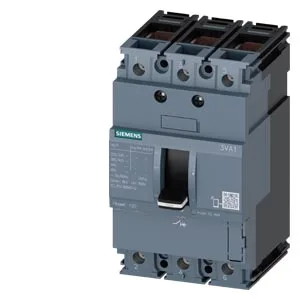
Its interrupting capacity varies sharply with system voltage: 121 kA at 240 VAC, 75.6 kA at 415 VAC, 52.5 kA at 440 VAC, and 11.9 kA at both 500 VAC and 690 VAC. That 121 kA at 240 V gives you substantial headroom for high-fault panels where the available short-circuit current is near the upper end of the distribution transformer's capability — a common scenario in North American 240 V delta or 277/480 V wye services with large upstream transformers. At 690 V the breaker still holds 11.9 kA, enough for light industrial loads on that voltage tier. That matters when you are coordinating with upstream switchgear that may have a lower rated impulse withstand — the 3VA series maintains coordination down to the listed let-through energy.
Thermal derating and continuous current
At 55 °C it drops to 49 A, at 60 °C to 48 A, at 65 °C to 46 A, and at 70 °C to 45 A. That is a gentle slope: roughly 0.2 A per degree above 50 °C. If your panel internal ambient runs at 60 °C (common in sealed enclosures with multiple heat sources), you still have 48 A of continuous capacity.
Integration and auxiliary options
No undervoltage release is fitted; if you need UVR for undervoltage protection, that is a different variant.