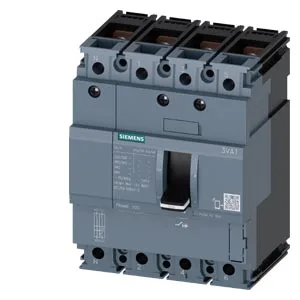
That 50 A rating holds flat from 40 °C up to 50 °C; above that it derates to 48 A at 55 °C, 47 A at 60 °C, 46 A at 65 °C, and 45 A at 70 °C. For a panel builder, that means you can load the breaker to its full nameplate in a 50 °C enclosure without a derate factor — most competitors start stepping down at 40 °C. Interrupting capacity is the headline here: 121 kA at 240 V, 75.6 kA at 415 V, 52.5 kA at 440 V, and 11.9 kA at 690 V. That 75.6 kA at 415 V is what drives the spec for most industrial panels in 400 V class — it gives headroom above typical 50–65 kA available fault currents on large transformers. The 690 V figure (11.9 kA) is lower but still useful for 690 V mining or marine distribution where fault levels are generally lower anyway.
That 101.6 mm width is a standard 4-pole MCCB footprint — it occupies four 25.4 mm (1-inch) modular spaces on a DIN rail or panel-mount base.
What it does not include
The auxiliary release slot is empty — if you need UVR or shunt trip, that's a separate order-code variant. The TM210 release is purely thermal-magnetic; no electronic trip unit, no adjustable long-time or short-time delay curves. For selectivity studies, treat it as a fixed thermal curve with a magnetic pickup around 500 A.