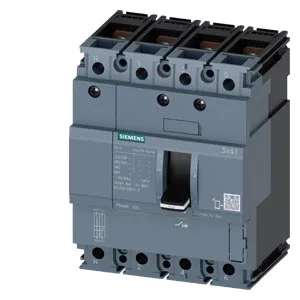
The 4-pole construction (3 phases + neutral) suits three-phase four-wire systems where the neutral needs overcurrent protection, common in North American and some IEC commercial installations.
The interrupting ratings span the voltage range a site electrical engineer cares about for SCCR coordination: 121 kA at 240 V AC, 75.6 kA at 415 V, 52.5 kA at 440 V, and 11.9 kA at both 500 V and 690 V. At 415 V — the common IEC industrial distribution voltage — 75.6 kA gives headroom above typical transformer fault levels (often 50–65 kA), so this breaker can serve as the main or tie in a switchboard without cascading upstream. The 690 V rating at 11.9 kA is lower but still covers most 690 V motor control center fault duties. The TM210 thermal-magnetic release provides fixed thermal and magnetic pickup settings; no electronic adjustability, but that also means no auxiliary power draw and no nuisance tripping from harmonics.
Built-in undervoltage release and panel fit
That means the breaker automatically trips when supply voltage drops below a threshold (typically 35–70 % of rated), protecting downstream equipment from brownout conditions or requiring a deliberate restart after a dip. The UVR is factory-fitted; no field kit needed. Physically, the breaker measures 130 mm high, 101.6 mm wide, and 70 mm deep — a 4-pole MCCB in a compact footprint that fits standard Siemens 3VA panelboard and switchboard mounting patterns.