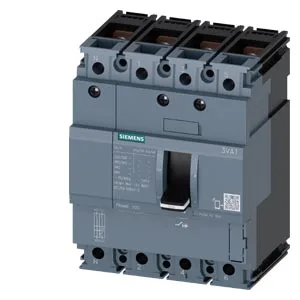
With 4 poles and a TM210 thermal-magnetic trip unit, it handles 50 A continuously at 40 °C and can break up to 121 kA at 240 V AC — that's the interrupting capacity you need for high-fault service-entrance or sub-distribution applications where the available fault current is substantial.
The interrupting rating drops as voltage rises: 75.6 kA at 415 V, 52.5 kA at 440 V, and 11.9 kA at both 500 V and 690 V. That 11.9 kA floor at 690 V is the number to check if you're feeding a 690 V motor control center — it's still adequate for most industrial MCC applications, but verify your worst-case bolted-fault calculation against that figure.
Temperature derating and continuous current
Above that, it steps down: 49 A at 55 °C, 48 A at 60 °C, 46 A at 65 °C, and 45 A at 70 °C.
Built-in undervoltage release
No separate UVR module to wire in.
Physical fit in the panel
Dimensions are 101.6 mm wide, 130 mm tall, and 70 mm deep — a standard 4-pole MCCB footprint that fits most DIN-rail or panel-mount enclosures.