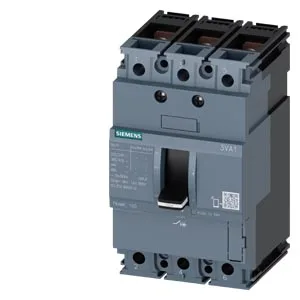
The integrated shunt trip (STL) allows remote tripping via a control signal, useful for emergency-off or supervisory shutdown circuits.
Breaking capacity — what the voltage columns mean
This MCCB's interrupting rating varies with system voltage, as the arc extinction energy changes. At 240 V it can clear 52.5 kA symmetrical; at 415 V that drops to 32 kA; at 440 V it's 13.6 kA; at 500 V and 690 V it holds at 7.5 kA. If your fault-current study shows available short-circuit current above these numbers at the panelboard, you need a higher-rated frame or upstream current-limiting fuses.
Above that, it derates linearly: 62 A at 55 °C, 61 A at 60 °C, 60 A at 65 °C, and 58 A at 70 °C. The case dimensions are 130 mm high, 76.2 mm wide, 70 mm deep — standard 3-pole MCCB footprint for DIN-rail or panel-mount.
What the shunt trip adds
The -0HA0 suffix indicates a factory-installed shunt trip (STL). This is a voltage-triggered auxiliary release that opens the breaker when a control voltage is applied — typically from a pushbutton, relay, or safety circuit. It does not include an undervoltage release (no UVR on this variant). If you need automatic trip on loss of control power, you'd want the UVR version. The shunt trip coil draw is not listed here, but standard Siemens STL modules pull roughly 0.5–1 A momentarily during tripping; confirm with the datasheet for your control transformer sizing.