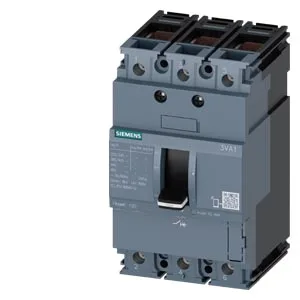
What this 63 A MCCB does on the line
The Siemens SENTRON 3VA1063-2ED36-0BH0 is a 3-pole molded case circuit breaker (MCCB) rated for 63 A continuous current at 40 °C, with a maximum breaking capacity of 52.5 kA at 240 V AC. That 52.5 kA figure means it can safely interrupt a short-circuit fault of that magnitude without welding its contacts or venting arc gas into the panel — critical for high-fault installations like a motor control center fed by a large transformer. The 800 V rated insulation voltage tells you the internal creepage and clearance are sized for 690 V line-to-line systems common in industrial plants.
Breaking capacity across the voltage range
This MCCB's interrupting rating drops as system voltage rises: 52.5 kA at 240 V, 32 kA at 415 V, 13.6 kA at 440 V, and 7.5 kA at both 500 V and 690 V. The 7.5 kA at 690 V is the floor — if your plant runs a 690 V distribution, verify that the available fault current stays under that number or step up to a higher-rated frame.
Thermal derating and panel fit
Rated 63 A from 40 °C up through 50 °C, then it starts to taper: 62 A at 55 °C, 61 A at 60 °C, 60 A at 65 °C, and 58 A at 70 °C. If this breaker lives in a crowded panel where ambient hits 60 °C, you lose 2 A — plan your load accordingly. The 76.2 mm width (3 in) and 70 mm depth (2.76 in) fit a standard MCCB footprint on DIN rail or panel-mount; the 130 mm height (5.12 in) leaves room for the undervoltage release module and auxiliary switch stack that ships with this variant.
Built-in auxiliaries and release
This order code includes 2 auxiliary switches plus 1 trip alarm switch (HQ), and an undervoltage release (UVR). The UVR trips the breaker when control voltage drops — common in emergency-stop chains or undervoltage protection schemes. No ground-fault monitoring or communication module on this variant; it's a straight line-protection device.
