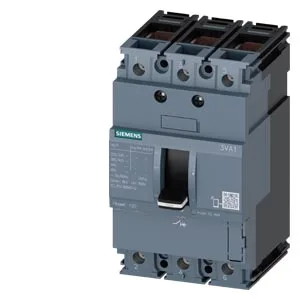
The 52.5 kA breaking capacity at 240 V tells you it handles high-fault points without cascading upstream; at 415 V it still interrupts 32 kA, which covers most secondary substation scenarios.
Above that it drops gradually: 62 A at 55 °C, 61 A at 60 °C, 60 A at 65 °C, and 58 A at 70 °C. Maximum power loss is 17.3 W, which matters for thermal budgeting in a sealed gland plate.
Breaking capacity by voltage
Breaking capacity drops as system voltage rises — that's the physics of arc extinction. At 240 V it's 52.5 kA; at 415 V it's 32 kA; at 440 V it's 13.6 kA; at 500 V and 690 V it's 7.5 kA. For a 400 V panel with a transformer rating under 2 MVA, the 32 kA figure usually gives enough SCCR headroom.
Auxiliary switching and trip indication
The shunt trip (STL) auxiliary release lets you trip the breaker from a remote pushbutton or a safety PLC output. No undervoltage release is fitted; if you need UVR for machine-safety disconnection, that's a different variant.
Depth is 70 mm, width 76.2 mm (3 inches), height 130 mm — that's a compact footprint for a 63 A MCCB with auxiliary switches. The shunt trip wiring requires a separate control voltage; verify polarity on the STL coil before energizing. Panel builders should account for the 17.3 W heat dissipation when calculating enclosure ventilation.