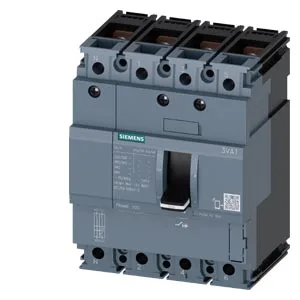
63 A MCCB with TM210 — the panel-builder's pick for line protection
The Siemens SENTRON 3VA1063-2ED42-0BC0 is a 4-pole molded case circuit breaker rated 63 A continuous at 40 °C, with no derating needed until you push past 55 °C. Breaking capacity hits 52.5 kA at 240 V, 32 kA at 415 V, and still holds 7.5 kA at 690 V, so it handles most industrial distribution panels without a fuss. The 70 mm depth and 101.6 mm width keep it within standard MCCB footprints for retrofit into existing SENTRON or third-party bases.
Above that, it steps down to 60.48 A at 55 °C and 56.7 A at 70 °C, so if the breaker lives near a furnace or in a hot rooftop enclosure, factor that into the load schedule. IP40 on the front keeps dust out of the mechanism; the rest of the breaker is open to the panel air, so don't mount it in a washdown zone without an enclosure.
Auxiliary contacts and undervoltage release — wired from the factory
The integrated auxiliary trip is factory-configured as a 3VA9608-0BB11 module, so replacement or spare ordering is a known part number.
The SENTRON series carries the usual Siemens compliance documentation — RoHS, REACH, and IEC/UL certifications are standard for the platform. No special documentation request needed for most panel builds.