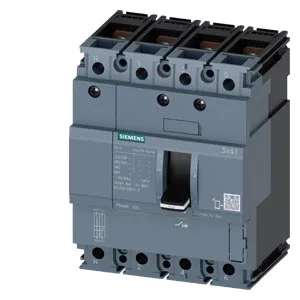
MCCB for line protection — 63 A continuous, 52.5 kA interrupting at 240 V
The Siemens 3VA1063-2ED42-0CA0 is a SENTRON molded case circuit breaker (MCCB) designed for line protection, carrying a continuous current rating of 63 A at 40 °C and derating to 58 A at 70 °C. Its interrupting capacity reaches 52.5 kA at 240 V, 32 kA at 415 V, and 7.5 kA at 690 V — figures that govern selectivity coordination in a distribution panel. The 4-pole construction with an undervoltage release (UVR) means this breaker drops out when supply voltage falls below the dropout threshold, protecting downstream loads from brownout damage.
At 240 V the breaker clears 52.5 kA symmetrical; at 415 V that drops to 32 kA, and at 690 V it holds at 7.5 kA. The 63 A rating holds flat from 40 °C to 50 °C; above that it derates linearly to 58 A at 70 °C. In a panel with ambient near 60 °C, expect 61 A continuous capability.
The 4-pole width (101.6 mm) is standard for a 4-pole MCCB in this frame size — it occupies four 25.4 mm module positions on a DIN rail or panel-mount footprint. The 70 mm depth leaves clearance for rear busbars or cable ducts in a typical 200 mm deep enclosure. No trip indicator or communication module is fitted; the undervoltage release is the only auxiliary release.