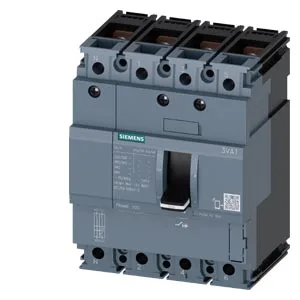
Its 63 A rated continuous current holds from 40 °C up to 50 °C without derating — above that, the TM210 thermal-magnetic release pulls back: 60.48 A at 55 °C, 59.22 A at 60 °C, 57.96 A at 65 °C, and 56.7 A at 70 °C. That curve matters if this breaker sits in a non-air-conditioned enclosure near a heat source; the continuous rating drops roughly 1.5 A per 5 °C step above 50 °C, so a panel designer sizing for a 60 A load at 60 °C needs the 59.22 A derated figure, not the 63 A nameplate. Breaking capacity is voltage-dependent: 52.5 kA at 240 V, 32 kA at 415 V, 13.6 kA at 440 V, and 7.5 kA at 690 V. The 690 V rating (7.5 kA) covers 600 V class drives and mining gear, though the capacity drops significantly at that voltage.
Built-in trip options and panel fit
The overcurrent release is a TM210 thermal-magnetic type — no electronics, no communication function, no phase-failure detection. That makes it a straightforward fit for standard feeder protection where you want the simplicity of a bimetal and solenoid trip without a power supply to the trip unit. A shunt trip (STL) is integrated as the auxiliary release, so remote tripping via a control signal is wired directly; the external trip accessory is order code 3VA9688-0BL32. No auxiliary contacts ship with the breaker — if you need a status feedback signal for a PLC or a panel lamp, you add them separately. Dimensions are 70 mm deep, 101.6 mm wide, and 130 mm high — a standard 4-pole MCCB footprint that drops into most SENTRON panelboards and DIN-rail adapters without a panel rework.
Environmental range and endurance
The 70 °C upper operating limit matches the derating curve above 50 °C — the breaker runs, but at a reduced continuous current.