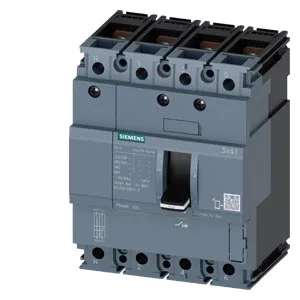
What this MCCB carries and where it fits
The Siemens SENTRON 3VA1063-3ED42-0AA0 is a 4-pole molded case circuit breaker rated 63 A continuously at 40 °C, with a TM210 thermal-magnetic overcurrent release. This is the line-protection version — no communication module, no ground-fault monitoring — built for straightforward branch-circuit protection in distribution panels. Breaking capacity runs 75.6 kA at 240 V AC, 52.5 kA at 415 V, and holds 7.5 kA all the way up to 690 V. That spread covers most low-voltage industrial feeds; the 690 V rating means it can sit on the secondary side of a 400 V–690 V step-up transformer without derating the interrupt rating. The TM210 release combines a thermal bimetal for overload protection and a magnetic coil for short-circuit trips — no electronic adjustment, no auxiliary power needed. Set it and forget it; the thermal curve tracks cable heating naturally.
Thermal derating — the real-world current
Full 63 A holds through 50 °C ambient. At 55 °C it drops to 62 A, at 65 °C to 60 A, and at 70 °C to 58 A. If the panel runs hot — say next to a drive stack or inside a non-climate-controlled enclosure — the 58 A floor at 70 °C is the number to design to, not the nameplate 63 A. Rated insulation voltage is 800 V, and the maximum operating voltage hits 690 V AC or 600 V DC. That DC rating is worth noting for battery-bank or UPS branch circuits — most MCCBs in this frame size don't carry a 600 V DC mark.
Panel fit and mounting
Footprint: 101.6 mm wide, 130 mm tall, 70 mm deep. The 70 mm depth is shallow enough for most 200 mm deep enclosures, leaving room for rear-mounted busbars or wiring ducts. IP40 on the front face means it's protected against tools and solid objects larger than 1 mm; fine for indoor panel installation, but not for washdown zones. Four-pole configuration covers three-phase plus neutral switching. The N-conductor protection design is marked 'Without' — meaning the neutral pole is switched but not protected (no overcurrent trip on the neutral). Standard for TN-S and TN-C-S systems where the neutral is bonded to ground at the source.
