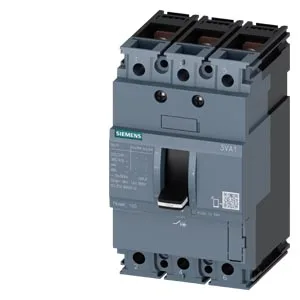
It's rated 63 A continuous at 40 °C ambient, and stays at 63 A up to 50 °C before it starts to derate: 62 A at 55 °C, 61 A at 60 °C, 60 A at 65 °C, and 58 A at 70 °C. That thermal curve matters when you're packing breakers into a hot enclosure — if your panel ambient runs 55 °C you lose 1 A per pole, not a showstopper, but at 70 °C you're down 5 A. The interrupting ratings are the headline: 121 kA at 240 V AC, 75.6 kA at 415 V AC, 52.5 kA at 440 V, and 11.9 kA at both 500 V and 690 V.
Dimensions are straightforward: 70 mm deep, 76.2 mm wide (3 inches), 130 mm tall (5.12 inches). That's a standard MCCB footprint — it'll drop into a panel cutout sized for a 3-pole SENTRON without surprises. The auxiliary switch configuration is built in: two auxiliary switches HQ plus a shunt trip (STL) release. If you need those, you're looking at a different suffix.
How it compares to a higher-rated sibling
If you're looking at the 3VA1110-5EF32-0AM0 as an alternative, the main difference is current rating and breaking capacity. That sibling is a 100 A frame with a higher interrupting rating at the same voltages. The 3VA1063-4ED32-0HC0 is a 63 A frame — it's physically smaller (70 mm deep vs the larger frame) and has lower power loss. The two are not footprint-compatible; you can't just swap one for the other without checking the bus bar spacing and enclosure cutout. The 3VA1063 is the right choice if your load is under 63 A and you want the smaller package. If you need 100 A, step up to the 3VA1110 frame.