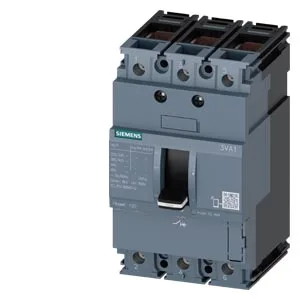
It carries a breaking capacity of 121 kA at 240 V and 75.6 kA at 415 V, which means it can safely interrupt fault currents up to those levels without cascading upstream — critical for high-fault panels where the upstream transformer or bus can deliver that energy.
Thermal derating — what the 63 A rating actually means in a warm panel
Above that, it derates: 60.48 A at 55 °C, 59.22 A at 60 °C, 57.96 A at 65 °C, and 56.7 A at 70 °C. If your panel ambient runs at 60 °C — common in a tightly packed enclosure with drives or transformers — you're effectively working with a 59 A breaker, not 63 A. Plan the load side accordingly; the TM210 release won't nuisance-trip if you stay under the derated curve.
The 76.2 mm width is a standard 3-pole MCCB footprint — three 25.4 mm pole pitches — so it drops into the same DIN-rail or screw-mount space as other 3-pole SENTRON breakers. Depth of 70 mm leaves room for rear busbar connections in a typical 200 mm deep enclosure.
Breaking capacity across voltages — selectivity planning
The breaking capacity varies by system voltage: 121 kA at 240 V, 75.6 kA at 415 V, 52.5 kA at 440 V, and 11.9 kA at 690 V. On a 480 V system (common in North America), the 440 V figure of 52.5 kA is the closest published rating — expect similar or slightly lower at 480 V.