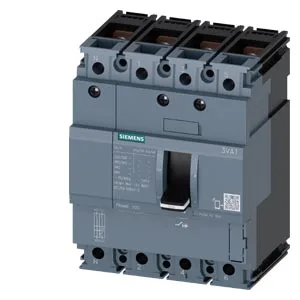
MCCB for line protection with UVR
Its TM210 thermal-magnetic release handles overload and short-circuit trip curves without electronic adjustment. The interrupting rating reaches 121 kA at 240 V AC and 75.6 kA at 415 V AC, so it can clear high-fault currents upstream of branch feeders without cascading failure. The breaker carries no communication module and no ground-fault monitoring; it is a straightforward thermal-magnetic device for fixed-distribution duty.
At 40 °C ambient the breaker holds 63 A without derating. The thermal curve holds flat to 50 °C, then drops to 62 A at 55 °C, 61 A at 60 °C, 60 A at 65 °C, and 58 A at 70 °C. The maximum power dissipation is 19.8 W at full rated current — a factor for enclosure heat budgeting.
The interrupting rating is voltage-dependent: 121 kA at 240 V, 75.6 kA at 415 V, 52.5 kA at 440 V, and 11.9 kA at both 500 V and 690 V. The 11.9 kA plateau at higher voltages means the breaker is not intended for high-fault 690 V distribution without upstream current-limiting fuses or a higher-rated MCCB ahead of it. For 400 V-class panels the 75.6 kA figure provides generous headroom for most industrial service-entrance applications.
The 4-pole width (101.6 mm) matches the standard 4-module MCCB footprint on DIN rail or bolted busbar. Depth of 70 mm leaves clearance for rear-connected busbars in a typical 200 mm deep enclosure.