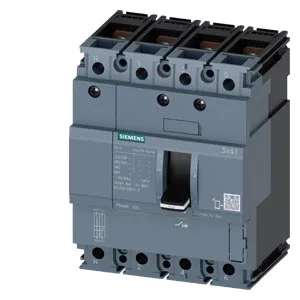
MCCB with a thermal-magnetic release and undervoltage coil
That makes it a straightforward choice for general line protection where you want simple, reliable overload and short-circuit response without a microprocessor in the trip path. No separate voltage-trip module to order; it's integrated.
The interrupting rating drops as the system voltage climbs — that's normal for any MCCB, but the curve here is worth noting because it stays high well into the 400 V range. At 240 V it's rated for 121 kA, at 415 V it's 75.6 kA, at 440 V it's 52.5 kA, and at 690 V it's 11.9 kA. For a 63 A frame, those are strong numbers; the 75.6 kA at 415 V means it can handle high-fault scenarios on a 400 V distribution board without needing an upstream current-limiting fuse.
The continuous current rating is 63 A from 40 °C up through 50 °C ambient. At 55 °C it derates to 60.48 A, at 60 °C to 59.22 A, at 65 °C to 57.96 A, and at 70 °C to 56.7 A. That's a gentle slope — about 10% total drop from 40 °C to 70 °C — so if your panel runs warm but stays under 50 °C, you get the full 63 A without any fudge factor.
Physical fit and auxiliary contacts
The auxiliary contact block is a 2-switch HQ version (two form-C contacts), which gives you status feedback for a PLC or remote indication without needing a separate add-on module.