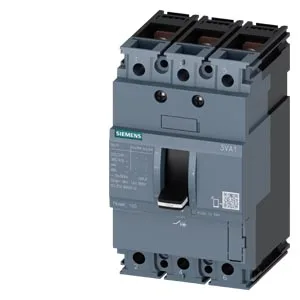
It's a three-pole unit rated 80 A continuous at 40 °C ambient, with a 52.5 kA interrupting capacity at 240 V AC. That's the headline number that tells you it can handle a serious fault without welding its contacts shut.
The 80 A rating holds steady from 40 °C up to 50 °C, then starts a gentle derate: 78 A at 55 °C, 77 A at 60 °C, 75 A at 65 °C, and 74 A at 70 °C. The 52.5 kA at 240 V drops to 32 kA at 415 V, 13.6 kA at 440 V, and 7.5 kA at 500 V and 690 V. That's a steep falloff as voltage climbs, so if you're feeding a 480 V bus, the 7.5 kA figure is your real available-fault-current ceiling.
This breaker ships with two built-in auxiliary switches (HQ type) and an undervoltage release (UVR). The auxiliary switches give you a dry contact for remote status indication or PLC input. The communication function is absent here; it's a straight electromechanical breaker, not a smart breaker with Modbus or PROFINET.
The can measures 130 mm high, 76.2 mm wide, and 70 mm deep — a standard 3-pole MCCB footprint that drops into most SENTRON panelboards or DIN-rail adapters. Max power loss is 21.7 W, so factor that into your enclosure thermal budget if you're packing a row of these in a sealed box. No trip indicator on the front, so you'll see the handle position but not a separate flag.