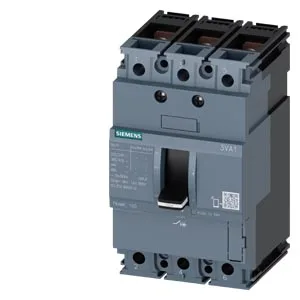
The Siemens SENTRON 3VA1080-2ED32-0DA0 is a 3-pole molded case circuit breaker rated for line protection, carrying 80 A continuous current at 40 °C through 50 °C without derating. At 55 °C it holds 76.8 A, and at 70 °C it still delivers 72 A — so in a warm enclosure near the top of its operating range you lose about 10 % of the nameplate. The interrupting ratings climb with system voltage: 52.5 kA at 240 V, 32 kA at 415 V, 13.6 kA at 440 V, and 7.5 kA at 690 V. The overcurrent release is a TM210 — thermal-magnetic, fixed-trip, the standard choice for general distribution and feeder protection where you don't need adjustable long-time or short-time pickup. An undervoltage release (UVR) is built in, so the breaker trips automatically if control voltage drops below the dropout threshold. No auxiliary contacts, no ground-fault module, no communication function — this is a straightforward line-protection MCCB, sized for a panel where the only accessory needed is the UVR. Dimensions: 130 mm tall, 76.2 mm wide, 70 mm deep — a standard 3-pole MCCB footprint that drops into a SENTRON mounting base or panel-mount kit.
Panel fit — what to check before you mount
The 76.2 mm width (roughly 3 inches) is the standard 3-pole MCCB pitch — it occupies three 25 mm module positions on a DIN rail. Line and load terminals accept copper conductors sized for the 80 A rating — typically 25–35 mm² depending on local code and ambient temperature. The TM210 release is factory-set and non-adjustable; if you need adjustable long-time pickup or a different trip curve, look at the 3VA1 series with electronic releases. The integrated undervoltage release requires a separate control voltage supply (typically 230 V AC or 24 V DC depending on the UVR coil ordered — verify the coil code against your control voltage).