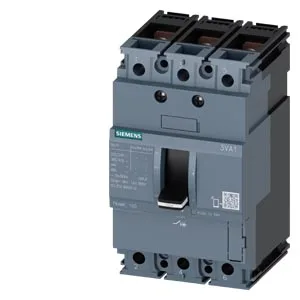
What this 80 A SENTRON MCCB carries
The Siemens SENTRON 3VA1080-3ED32-0CA0 is a 3-pole molded case circuit breaker rated for 80 A continuous current at 40 °C, with a TM210 thermal-magnetic release. The TM210 is a fixed thermal, fixed magnetic trip — no adjustment dials, which means the trip curve is locked at the factory. That simplifies spec-in for a BOM line where you want no field-tamper risk on the overcurrent protection. Breaking capacity runs 75.6 kA at 240 V, 52.5 kA at 415 V, 32 kA at 440 V, and 7.5 kA at 690 V. The operating temperature range is -25 °C to 70 °C, and the current derating curve starts at 55 °C — 76.8 A at 55 °C, dropping to 72 A at 70 °C.
The 70 mm depth and 76.2 mm width fit the standard SENTRON 3VA footprint; if you're replacing a 3VA1 frame from an earlier generation, the mounting holes and bus-bar spacing are the same pattern. No auxiliary contacts are built in, and there is no communication module or phase-failure detection on this variant. The undervoltage release (UVR) is included — that's the 3VA9608-0BB24 auxiliary trip unit. If the panel design calls for a shunt trip or an alarm contact, those need to be added externally via the accessory slot.
What the TM210 release means for coordination
The TM210 is a thermal-magnetic release with a fixed thermal pickup at 80 A (1.0 x In) and a fixed magnetic pickup at 10 x In (800 A). No adjustment range. For a motor branch circuit, the 10x magnetic instant trip clears a locked-rotor fault without nuisance tripping on inrush, but for a transformer or capacitor bank you'd want to check the inrush profile against the 10x threshold. For a resistive load or a distribution feeder, the fixed curve is straightforward to coordinate with downstream MCBs.