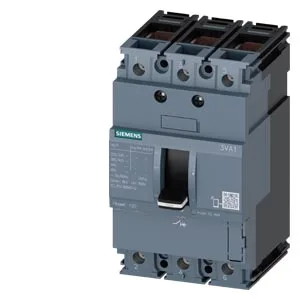
Its 75.6 kA breaking capacity at 240 V and 52.5 kA at 415 V give it the headroom to clear high-fault scenarios without cascading upstream — critical for selectivity studies on industrial feeders.
Above that it derates linearly: 78 A at 55 °C, 77 A at 60 °C, 75 A at 65 °C, and 74 A at 70 °C (–). The maximum power loss of 21.7 W is manageable for a standard DIN-rail enclosure but worth checking against the cabinet thermal budget in high-density layouts.
The interrupting ratings span the common industrial voltages: 75.6 kA at 240 V, 52.5 kA at 415 V, 32 kA at 440 V, and 7.5 kA at both 500 V and 690 V (–). The steep drop above 440 V means that on 690 V systems this breaker is suited only for low-fault locations or where upstream current-limiting devices keep the prospective fault below 7.5 kA. For 400 V class panels (415 V nominal) the 52.5 kA figure covers most transformer-fed services.
Integrated auxiliary and release options
The trip indicator gives a visual flag on the breaker face, speeding fault isolation during commissioning or troubleshooting.
Mechanical fit and environmental range
The 3-pole width (76.2 mm) is standard for SENTRON 3VA frames — it fits the same DIN-rail footprint as other 3VA three-pole breakers, so swapping into an existing panel that was laid out for a 3VA1110 variant is straightforward as long as the lug positions and busbar spacing match.