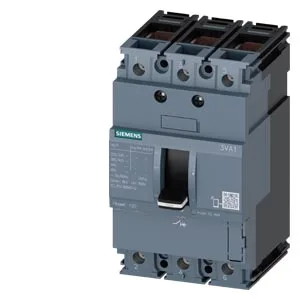
Siemens SENTRON 3VA1080-3ED36-0JA0 — 80 A MCCB with Shunt Trip
It carries a 75.6 kA interrupting capacity at 240 VAC, stepping down to 7.5 kA at 690 VAC — the 240 V figure is the one that governs most North American feeder applications, while the 690 V rating confirms it handles European 400 V industrial grids with headroom. The integrated shunt trip (STL) release lets a remote signal or safety circuit trip the breaker independently of overload or short-circuit conditions, which is typical for emergency-off or interlock schemes. The TM210 thermal-magnetic release provides inverse-time overload protection and instantaneous short-circuit response — standard for motor branch circuits and general distribution where no electronic adjustment is needed.
The 76.2 mm (3 in) width is the standard footprint for a 3-pole SENTRON 3VA frame at this rating — it occupies three 25 mm module positions on a DIN rail or mounts directly on a backplate with the supplied screws.
Breaking Capacity by Voltage — Selectivity Planning
The interrupting ratings span the voltage range a panel builder actually encounters: 75.6 kA at 240 V, 52.5 kA at 415 V, 32 kA at 440 V, and 7.5 kA at both 500 V and 690 V (–). For a 400 V distribution board with 50 kA available fault current, this breaker's 52.5 kA at 415 V gives a slim margin — coordination upstream with a current-limiting fuse or a higher-rated SENTRON 3VA frame is worth modeling if the transformer size pushes fault levels above 50 kA. At 240 V the 75.6 kA covers virtually all North American panelboard applications.
Temperature Derating Curve
At 55 °C it derates to 78 A, at 60 °C to 77 A, and at 65 °C to 75 A (–). At 70 °C it still carries 74 A. If the breaker sits next to a heat source or in an unventilated enclosure, the 65 °C derating point is the one to design around — losing only 5 A from the nominal rating means the thermal design is forgiving.