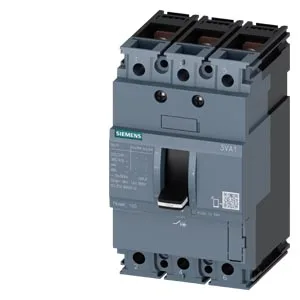
The interrupting capacity hits 121 kA at 240 V AC, 75.6 kA at 415 V, and 52.5 kA at 440 V — numbers that govern selectivity and SCCR headroom in a distribution panel. At 690 V it still clears 11.9 kA, so it handles the high-side of a 480 V step-up transformer secondary without cascading upstream. Rated continuous current holds flat at 80 A from 40 °C through 50 °C ambient; above that it derates to 76.8 A at 55 °C, 75.2 A at 60 °C, 73.6 A at 65 °C, and 72 A at 70 °C. Mounting is DIN-rail compatible at 76.2 mm wide (roughly 3 x 25.2 mm per pole), 130 mm tall, and 70 mm deep. That depth is the dimension to check against gland-plate clearance or a shallow enclosure back wall.
This variant ships with two HQ auxiliary switches and a shunt trip (STL) undervoltage release. The shunt trip is wired separately from the main load path — it needs a control voltage to hold the breaker closed; loss of that voltage trips the mechanism. No undervoltage release is fitted, so the shunt trip is the only remote-trip path. The integrated auxiliary trip is order code 3VA9688-0BL32, which is the factory-fitted accessory for this specific build. No communication function, no phase failure detection, no ground fault monitoring — this is a plain line-protection breaker, not a power-monitoring device.
Mechanical endurance and environmental limits
The latching mechanism is rated for 15,000 operations — adequate for a distribution feeder that cycles a few times a year, not for a motor-starting duty where the breaker opens under load weekly.